OKX Card Review 2026: 2% Cashback, $5 Monthly Cap, and the US Launch
The short version of this OKX Card review: if you already hold stablecoins, there is little reason to skip it. What most English-language reviews skip over is that regular (non-VIP) users cap out at just $5 in monthly cashback on OKX’s general USD schedule (50 EUR on the EEA schedule) — and that changes the math a lot more than the 2% headline rate suggests.
If you are reading this from the mainland US, the global card this review covers is not the one for you — OKX now runs a separate OKX United States Card, live on its US card page as of November 4, 2026 for eligible customers in select states (not Massachusetts or New York). Canada, Hong Kong and India are fully off-limits under OKX’s own restriction list; the UK, Australia, Singapore and several other English-speaking markets can use the global card conditionally once the app actually shows a Card entry.
Key Takeaways
- Non-VIP users hit the $5/month cashback cap after just $250 of USDG spend on the general USD schedule (EEA cardholders get 50 EUR on 2,500 EUR of spend) — the 2% rate stops mattering past that point
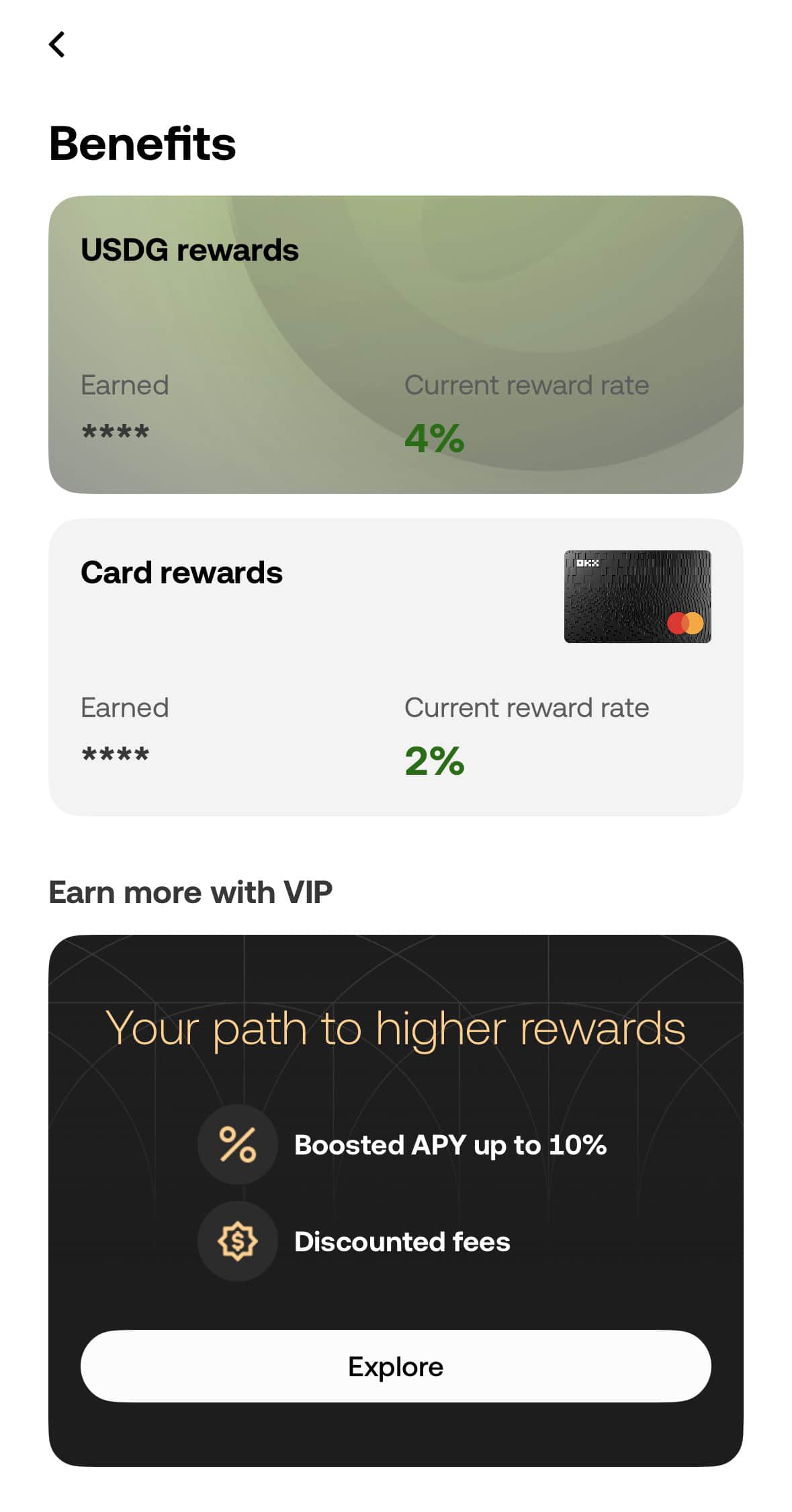
- OKX’s card pages list 4% USDG APY for regular users on balances up to $10,000 (3.5% base rate above that) and up to 10% at the top tier; the separate USDG Rewards page (last updated March 2026) still shows 3.5% and 4.1% — check your tier in-app
- Mainland US readers need the separate OKX United States Card, now live for eligible customers in select states (not Massachusetts, New York or US territories), with its own 2% to 10% tier table; the global card in this review is not for US residents
- Canada, Hong Kong and India are on OKX’s official full-restriction list — the card, and every other OKX service, is unavailable there, full stop
- Fees stay global and simple: 0% transaction fee, 0% FX fee, and a 0.1% stablecoin-to-fiat market spread at checkout
- Ether.fi Core pays 3% on the first $2,000/month (in ETHFI); OKX’s $5 ceiling for regular users makes it the lower-cashback card at almost any spend level, its edge is a stable USDG payout
- UK, Australia, Singapore, New Zealand, the Philippines, Nigeria, Pakistan and the UAE are not on OKX’s restriction list, so the global card is conditionally available once the app shows a Card entry
What OKX Card is and what we checked
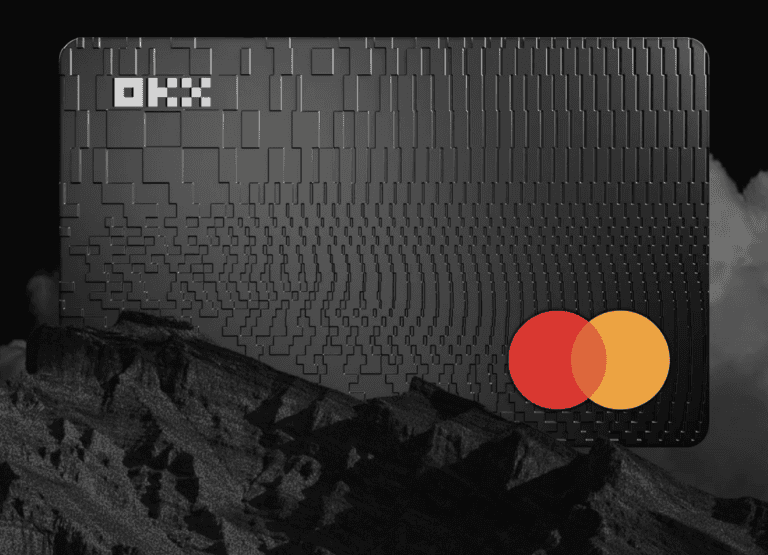
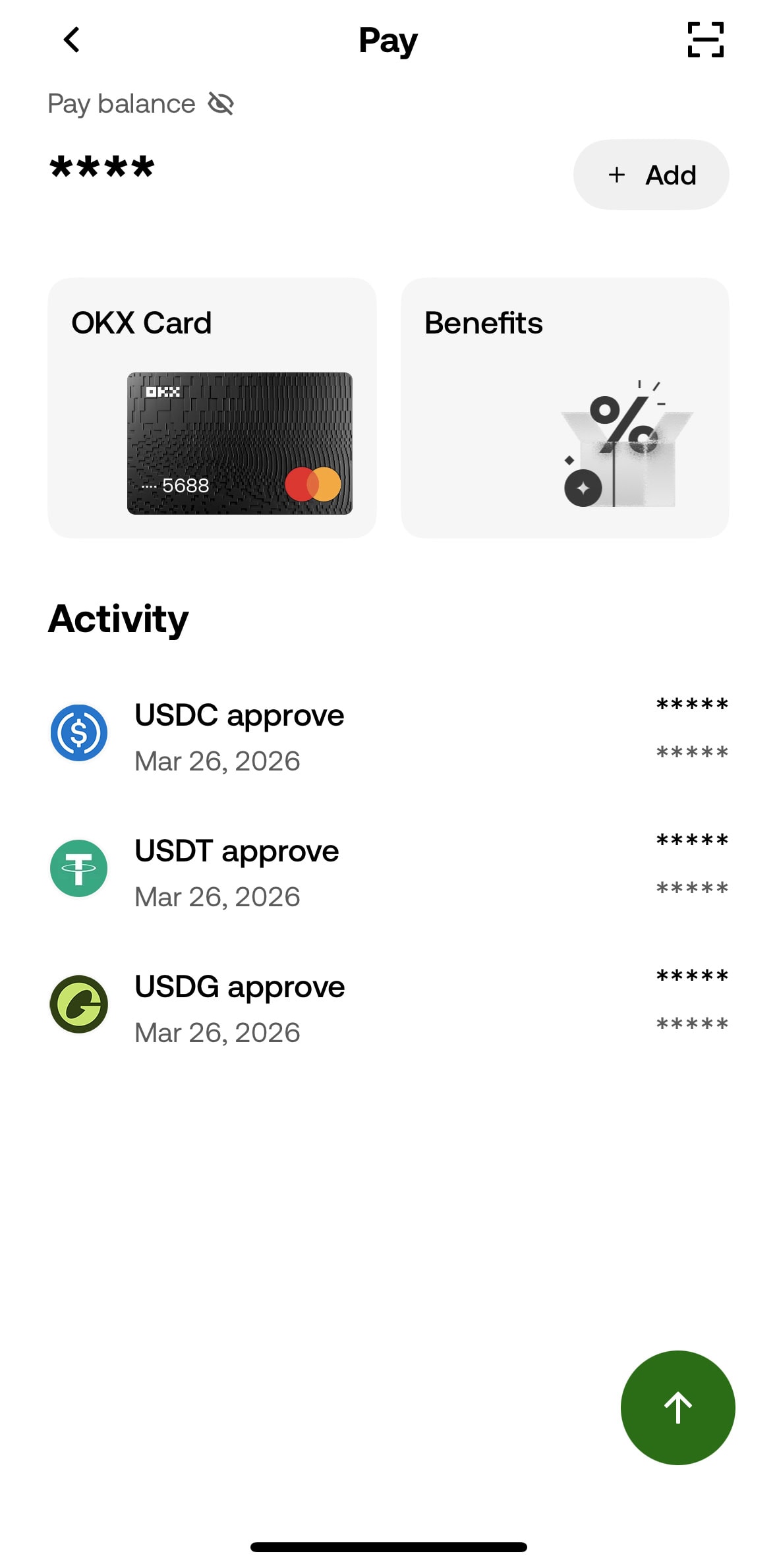
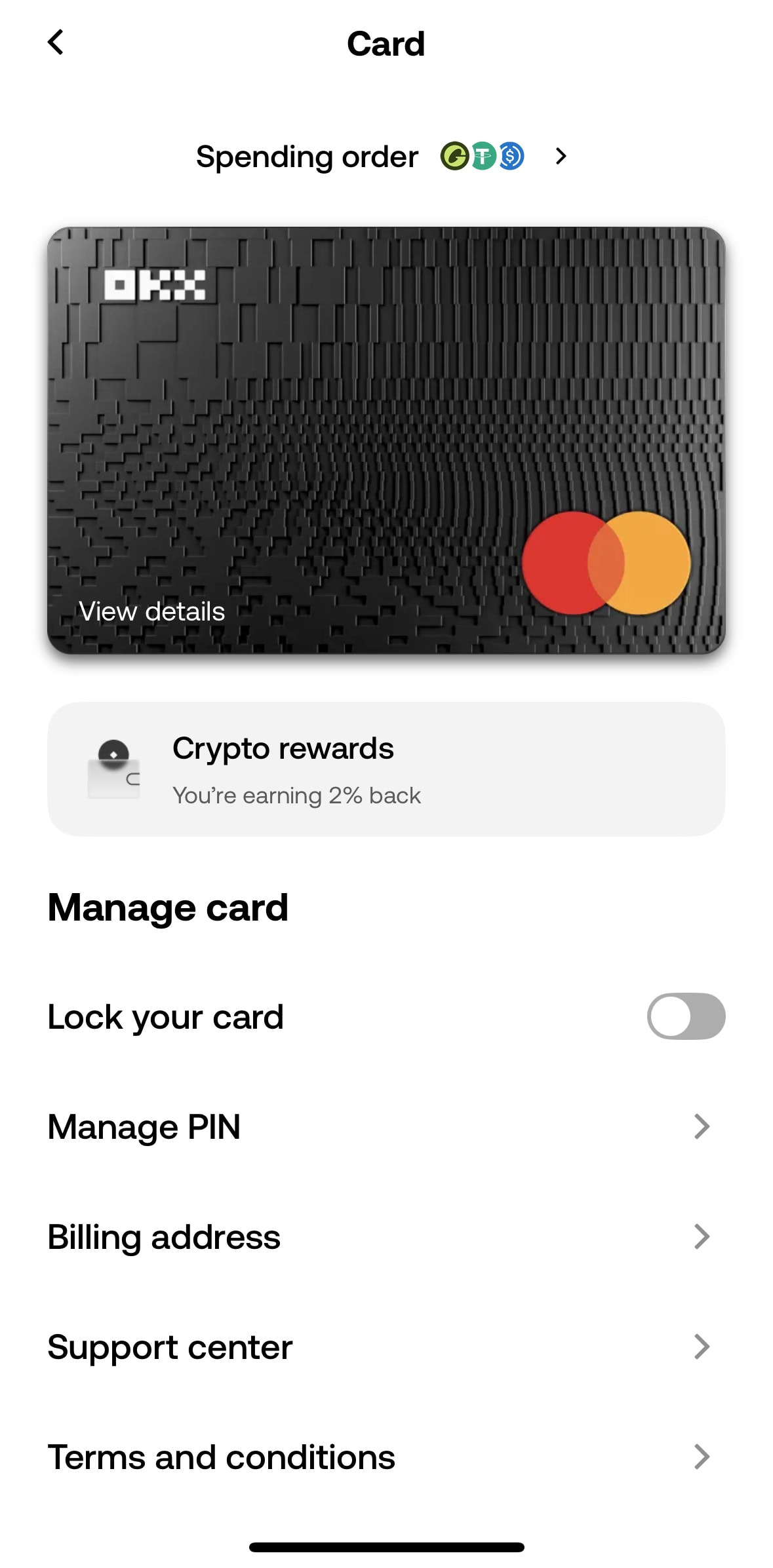
OKX Card is a virtual Mastercard funded from your OKX Pay balance in USDG, USDT or USDC. Activation is instant once the app shows a Card entry, and you can add it straight to Apple Pay or Google Pay. A physical card exists only as a waitlist feature right now, with no published country list for when it ships.
OKX does not publish a country list; the card is available where the app shows a Card entry. The site owner activated a virtual card in March 2026 (the Pay home and card-management screens below are from that account). The one setting that matters: put USDG first in Spending order, because only USDG purchases earn cashback.
If you do not have an OKX account yet, start with our OKX registration and deposit guide, finish KYC, then come back to apply for the card. The application steps and fee structure are covered in full in our OKX Card application tutorial — this review focuses on what actually happens after you start using it.
Monthly cashback math: why spend matters more than the headline rate
OKX advertises 2% cashback for regular (non-VIP) users, which sounds solid. The number that actually determines your payout is the monthly cap, and most reviews skip it entirely.
Under OKX’s general cashback FAQ, regular users are capped at $5 in cashback per month. At 2%, that ceiling is reached at exactly $250 of USDG spend. Every dollar you spend past $250 earns nothing extra that month. OKX’s general cashback FAQ (updated September 25, 2026; amounts in USD) lays out five tiers in total:
| Tier | Cashback rate | Monthly cap | Spend to hit cap |
|---|---|---|---|
| Non-VIP | 2% | $5 | $250 |
| VIP1 | 4% | $100 | $2,500 |
| VIP2 | 4.5% | $200 | $4,400 |
| VIP3 | 5% | $800 | $16,000 |
| VIP4+ | 10% | $800 | $8,000 |
Those USD figures are the general schedule. Two region-specific OKX pages list different numbers, so check which one governs your card. For EEA cardholders (the EU plus Norway; Iceland and Liechtenstein are excluded), the EEA cashback FAQ (updated September 28, 2026) works in euros:
| EEA tier | Cashback rate | Monthly cap | Spend to hit cap |
|---|---|---|---|
| Non-VIP | 2% | 50 EUR | 2,500 EUR |
| VIP1 | 4% | 300 EUR | 7,500 EUR |
| VIP2 | 4.5% | 450 EUR | 10,000 EUR |
| VIP3 | 5% | 1,000 EUR | 20,000 EUR |
| VIP4+ | 10% | 1,000 EUR | 10,000 EUR |
OKX’s South Asia card page (updated August 26, 2026) lists VIP3+ at 8% with an $800 monthly cap and VIP4+ at 10% with an $800 cap; its non-VIP, VIP1 and VIP2 rows match the general table above.
Here is what that looks like for real spending levels, assuming $1,000 of USDG held for passive interest at the same time:
| User type | Monthly spend | Card cashback (2%) | USDG yield on $1,000 (4% non-VIP card APY) | Total monthly gain |
|---|---|---|---|---|
| Light user | $100 | $2.00 | $3.33 | $5.33 |
| Medium user | $300 | $5.00 (capped) | $3.33 | $8.33 |
| Heavy user | $800 | $5.00 (capped) | $3.33 | $8.33 |
| VIP1 | $800 | $32.00 | $5.00 (6% tier) | $37.00 |
The yield column uses the 4% regular-user APY that OKX’s card pages list for balances up to $10,000 (3.5% base rate above that cap; the VIP1 row uses its 6% tier). OKX’s separate USDG Rewards page, last updated March 2026, still shows 3.5% for regular users and 4.1% for VIPs, so the two pages disagree. Rates can change, so confirm your current rate in the app before relying on a precise number.
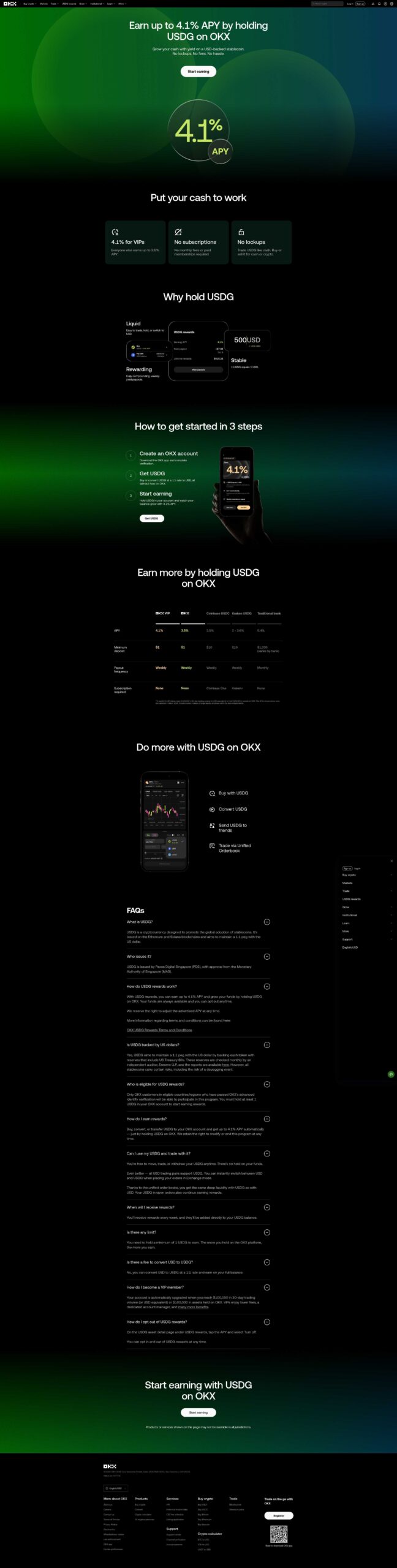
Bottom line: VIP1 depends on $100,000 in assets or $1,000,000 in 30-day trading volume, not on card spend — so for most regular users the 2% headline rate and the $5 monthly cap are the entire cashback story.
Based on OKX’s official cashback FAQ, updated September 25, 2026
Can you actually get OKX Card in the US, Canada, Hong Kong or India?
This is where generic “may not be available in all jurisdictions” language on OKX’s card page stops being useful, so here is what the official sources actually say for each market.
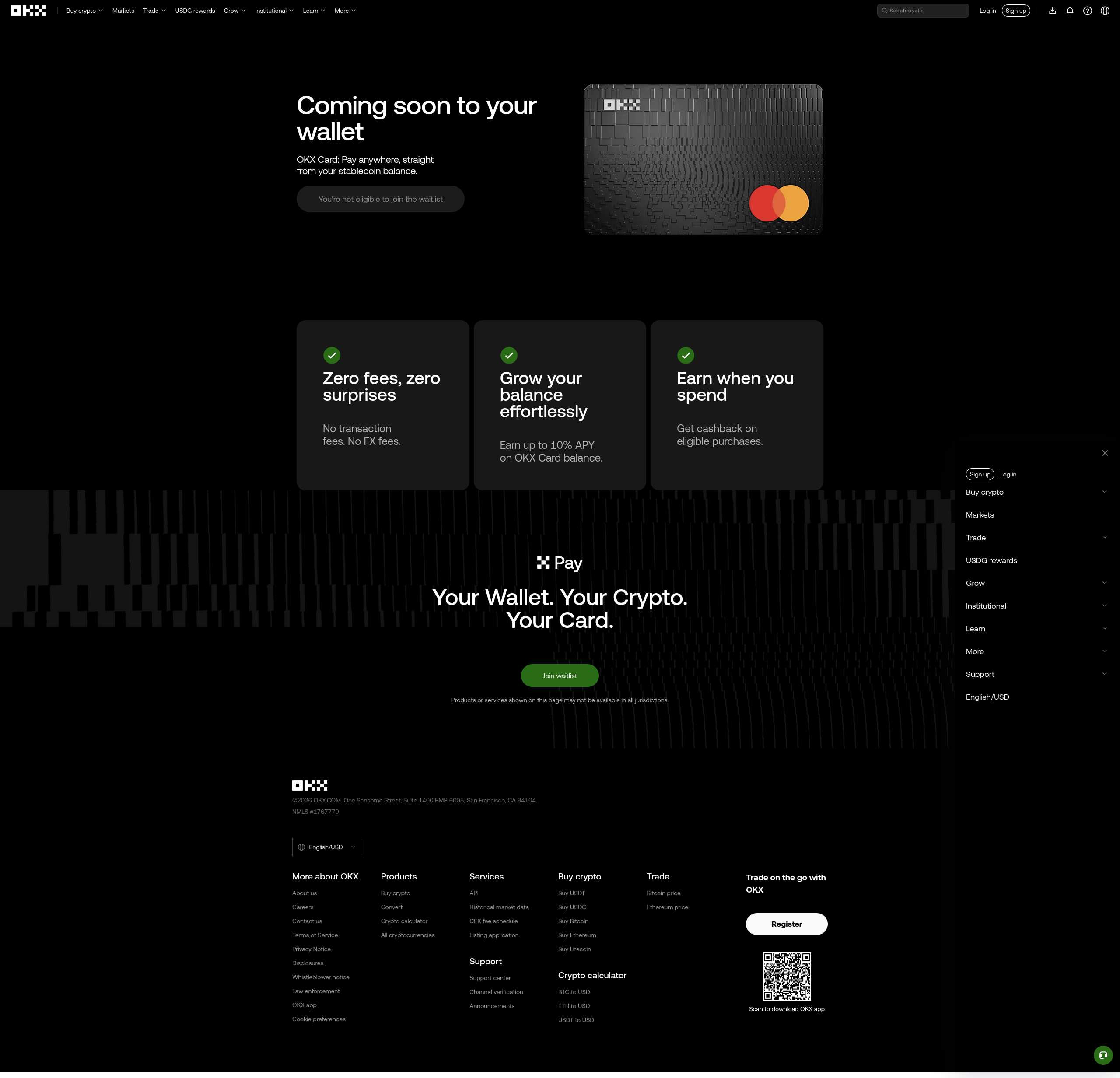
- Mainland US: yes, through a separate card. The official OKX United States card page now shows a “Get my card” button instead of a waitlist (re-opened November 4, 2026). It is a secured charge card issued by WebBank under a separately registered OKX US entity: spending is backed by USDC, USDT or USDG, there is no APR, and each statement must be repaid in full. You need a fully verified OKX account, OKX Pay enabled and a pass on the in-app eligibility checks. OKX lists availability for eligible customers in select states and territories, excluding Massachusetts, New York, American Samoa, Guam, the Northern Mariana Islands, Puerto Rico and the U.S. Virgin Islands. It is virtual only at launch, with no transaction or FX fees. The tier table is (Classic 2% capped at $50/$2,500 spend; Plus 4% capped at $400/$10,000 spend; Premium 4.5% capped at $900/$20,000 spend; Signature 5% capped at $1,500/$30,000 spend; Infinite 10% capped at $1,500/$15,000 spend, cashback paid in USDG and only on USDG purchases repaid through Autopay) — that is a different program from the global card reviewed above.
- Canada, Hong Kong, India: not available at all. OKX’s official risk and compliance disclosure puts all three on its full-restriction list, meaning every OKX service — not just the card — is unavailable, not merely “check the app and see.”
- UK, Australia, Singapore, New Zealand, Philippines, Nigeria, Pakistan, UAE: conditionally available. None of these are on OKX’s full-restriction list, so the global card can be activated once the app shows a Card entry for your account. Australia, the UK and South Korea do have partial restrictions on derivatives and P2P services; OKX’s disclosure does not name card or spot access in those restrictions, though that is not the same as an explicit confirmation that the card works there — treat it as likely available, not guaranteed.
No official OKX source publishes a specific KYC document checklist for the card beyond the standard exchange verification flow, so treat that step as unconfirmed until you reach it in the app. This review does not make any general “licensed” or “regulated” claim about either program; the one verified issuer fact is that the US card is tied to WebBank and a separately NMLS-registered OKX US entity, which is a launch-status and issuer detail, not a statement about the Card’s legal status anywhere else.
November 2026 update: OKX’s US card page no longer shows a waitlist. It now has a “Get my card” button and states the card is available to eligible customers in select states and territories, excluding Massachusetts, New York, American Samoa, Guam, the Northern Mariana Islands, Puerto Rico and the U.S. Virgin Islands. The earlier “coming soon” status no longer applies, so the US tier table above is the live one.
Everyday spending: convenience stores, subscriptions and overseas purchases
Here is what OKX’s own rules mean for each spending scenario.
Convenience stores and in-person retail
Once the card is in Apple Pay or Google Pay, it works at any shop that accepts Mastercard contactless; the physical card is still waitlist-only, so in-store use is phone-based. Cashback is paid in USDG to your Pay account rather than at the end of a billing cycle.
Online subscriptions
For Spotify, YouTube Premium and similar subscriptions you enter the card number directly — no Apple Pay needed online. One thing worth flagging: some subscription services run a $1 authorization hold first, and that small charge also runs through your Spending order, so it draws from whichever balance you set as the priority.
Settlement speed and transaction tracking
This is where OKX Card is strongest. USDG cashback goes to your Pay account instead of waiting for a statement to close, the way a traditional credit card works. The app shows the exact charge amount, which stablecoin was used, and the cashback earned for every single transaction.
OKX Card vs Ether.fi Card
OKX Card and Ether.fi Card are two of the most-discussed crypto cards right now — one leads with zero fees, the other with a much higher cashback ceiling. Here is the actual comparison at $500 of monthly spend.
| Comparison | OKX Card | Ether.fi Card |
|---|---|---|
| Card type | Mastercard debit | Visa credit (Cash) |
| Spending cashback | 2% (USDG only, $5/month cap) | Core: 3% on the first $2,000/month, then 1%/0.5% (paid in ETHFI, 7-day lock) |
| Transaction fee | 0% | 0% |
| FX fee | 0% | Core 0.5% (Luxe 0.25%; none on USD/EUR) |
| Stablecoin conversion spread | 0.1% | Not listed |
| Cost at $500/month spend | $0.50 (0.1% spread) | ~$2.50 (Core 0.5% FX on non-USD/EUR spend) |
| Cashback at $500/month spend | $5.00 (capped) | ~$15 (Core 3%, in ETHFI) |
| Net monthly gain | +$4.50 | ~+$12.50 (in ETHFI, price-volatile) |
| Holding yield | USDG yield (4% for regular users on balances up to $10,000 per OKX’s card pages; check the app) | — |
| Cashback currency | USDG (stablecoin) | ETHFI (price-volatile) |
| Card issuance fee | Free | Core virtual card free; physical card $60 incl. shipping |
| Custody model | OKX Pay (exchange-custodied) | Non-custodial (DeFi wallet) |
On cashback, Ether.fi is clearly higher: Core pays 3% on the first $2,000/month, so $500 of spend earns about $15 (in ETHFI), where OKX Card caps out at $5 once you pass $250. The trade-off is that Ether.fi Core adds a 0.5% FX fee on non-USD/EUR spend, about $2.50 on $500.
When does OKX Card win instead?
On paper, even at $250/month Ether.fi Core (3% cashback minus 0.5% FX) still beats OKX (2% cashback minus a 0.1% spread). OKX’s advantage is that its cashback is paid in USDG, a stablecoin that does not move with crypto prices, with no 7-day lock; Ether.fi’s cashback is paid in ETHFI, which shrinks in dollar terms whenever the token drops.
Many readers hold both cards and split spending: smaller everyday purchases on OKX Card (no FX fee), larger purchases on Ether.fi Card (higher cashback ceiling). If you are reading this from Kenya, our OKX Card in Kenya guide covers local funding routes. Malaysia is on OKX’s own Restricted Locations list, so the global card is not an option for residents there.
What I did not like about OKX Card
1. The $5 monthly cap is too low for a “headline 2%” card
This is the biggest hidden limit for regular users. A 2% rate sounds appealing, but the $5 cap means every dollar you spend past $250 earns exactly nothing that month. Even reaching VIP1’s $100 cap requires $2,500 of monthly spend — cashback that actually feels meaningful needs real volume, which most casual users will never hit. OKX’s funnel is clear: the 2% rate gets you to open the card, but the caps do the real work of limiting payout.
2. USDG is less liquid than USDT
Earning the 2% cashback requires setting Spending order to prioritize USDG, which means holding USDG. The problem is USDG’s liquidity outside the OKX ecosystem lags far behind USDT. Moving USDG to another exchange is not always supported, and converting it to cash through local off-ramps has fewer routes than USDT does. OKX’s internal USDG-to-USDT swap is fee-free, but that is still an extra step most users would rather skip.
3. OKX can change the USDG rate at any time
USDG yield is not fixed and OKX can adjust it; OKX’s card pages currently list 4% for regular users on balances up to $10,000 (3.5% above that), while the USDG Rewards page (last updated March 2026) lists 3.5%. If you are chasing yield, check the current number in the app first.
Who it fits and who should skip it
My recommendation is straightforward and depends heavily on where you are reading this from.
Worth getting if you are…
- Already using OKX in a non-restricted market: your stablecoins are already on the exchange, so opening the card just adds a spending channel; the USDG holding yield (4% for regular users on balances up to $10,000 per OKX’s card pages; check the current rate in the app) is passive income you earn anyway
- A frequent overseas spender: 0% FX fee plus a 0.1% conversion spread beats the roughly 1.5% foreign-transaction fee most bank credit cards charge
- Looking for stablecoin passive income: even without spending, parking USDG in OKX Pay still earns a holding yield (4% for regular users on balances up to $10,000 per OKX’s card pages), which can beat many savings-account rates — confirm the current rate in the app
Skip it if you are…
- A mainland US reader: the global card is not for you; look at the separate OKX United States Card instead (not offered in Massachusetts, New York or US territories), which has a different tier structure
- In Canada, Hong Kong or India: OKX is fully restricted in all three markets — there is no workaround through the app
- Mainly on Binance or another exchange: moving assets over just for OKX Card is not worth the conversion cost and hassle; Ether.fi Card or Bybit Card are easier if you are not already an OKX user
- Spending under $100/month: cashback comes out under $2, and the USDG APY on a small balance is minor too — the setup time is not worth it at that volume
OKX Card FAQ
Can US residents apply for OKX Card?
Yes, if you live in a state OKX serves and pass the in-app checks. The official OKX United States card page now shows a “Get my card” button instead of a waitlist. It is a separate card issued by WebBank, available to eligible customers in select states and territories, excluding Massachusetts, New York, American Samoa, Guam, the Northern Mariana Islands, Puerto Rico and the U.S. Virgin Islands, with its own tier table. The global card covered in this review is not available to mainland US readers.
Is OKX Card available in Canada, Hong Kong or India?
No. OKX’s official risk and compliance disclosure puts Canada, Hong Kong and India on its full-restriction list, meaning every OKX service, including the card, is unavailable in those markets — not a case of checking whether the app shows a Card entry.
How much can I actually earn in OKX Card cashback per month?
Regular (non-VIP) users earn 2%. On the general USD schedule the cap is $5/month, reached at $250 of spend; VIP1 earns 4% capped at $100 ($2,500 spend); VIP2 earns 4.5% capped at $200 ($4,400 spend); VIP3 earns 5% capped at $800 ($16,000 spend); VIP4+ earns 10% capped at $800 ($8,000 spend), with caps calculated in AST (UTC+3). OKX’s EEA FAQ uses euros and CET (GMT+1): non-VIP 2% capped at 50 EUR (2,500 EUR of spend), VIP3 5% capped at 1,000 EUR, VIP4+ 10% capped at 1,000 EUR. OKX’s South Asia page lists VIP3+ at 8% with an $800 cap. Caps reset on the 1st of each calendar month; check the time zone in your in-app terms.
What fees does OKX Card charge?
0% transaction fee and 0% FX fee on card purchases. Converting your stablecoin balance to fiat at checkout carries a 0.1% market spread, per OKX’s official FAQ.
Should I get OKX Card or Ether.fi Card?
On headline numbers, Ether.fi Core’s 3% on the first $2,000/month (paid in ETHFI, 7-day lock) beats OKX’s 2% capped at $5, even after its 0.5% FX fee on non-USD/EUR spend. OKX’s edge is a stable USDG payout and a 0.1% spread. Many users hold both and split spending by amount.
When does USDG holding interest get paid, and how much?
Interest is paid weekly per OKX’s USDG Rewards page, whose March 2026 figures were 3.5% for regular users and 4.1% for VIPs; OKX’s card pages now list 4% for regular users on balances up to $10,000, with amounts above that falling back to 3.5%. Confirm your current tier in-app. At 4%, $1,000 of USDG earns about $3.33/month and $5,000 about $16.67/month, or about $200/year, with no lock-up period.
Which purchases are excluded from OKX Card cashback?
Money transfer services (MCC 4829 and similar), pawn shops, ATM cash withdrawals (MCC 6011), and loan or debt repayments to financial institutions do not earn cashback, per OKX’s cashback FAQ. The same FAQ also excludes securities, insurance, gambling and lotteries, tax and government payments, charities and professional services.
Final verdict: is OKX Card worth it?
On fee structure alone, OKX Card is genuinely one of the most competitive crypto cards available: 0% transaction fee, 0% FX fee, and only a 0.1% conversion spread, plus cashback and holding yield on top. That combination beats most competitors on paper.
- $5/month cashback cap for regular users, reached at $250 of spend
- USDG liquidity outside OKX lags behind USDT
- USDG yield can be changed by OKX at any time
- The global card is not usable for mainland US, Canada, Hong Kong or India readers (the US has its own separate card)
That is the real ceiling, not just a formality. My take: if you already use OKX in an eligible market, this is close to a no-brainer — opening the card costs nothing, and the USDG APY alone makes it worthwhile. If you are not an OKX user yet and are only weighing whether to join because of the card, treat it as a nice extra, not the main reason — check your market’s status above first.
No OKX account yet? Start with our full OKX registration and deposit guide, finish registration and KYC, then apply for the card. For the application steps, fee table and USDG cashback mechanics, see our OKX Card application tutorial.
This article contains referral links. Applying through our OKX Card link does not cost you anything extra, and we may earn a small commission. This review is based on OKX’s own published pages and the site owner’s March 2026 in-app screenshots, not sponsored by OKX. Cashback tiers, USDG yield and fees were re-checked against official OKX sources on November 3, 2026 (the US card status is as of November 4, 2026), and can change without notice — confirm current figures in the app before relying on them.