KAST Card vs RedotPay (2026): Fees, Cashback and Which One You Can Get
Key takeaways
- Where you live decides first. RedotPay lists the United States on its KYC, card-issuance and card-delivery restriction lists, and it does not issue cards in India, Indonesia, Singapore or Turkey. KAST has a verification path for US residents; elsewhere its sign-up country list decides.
- Everyday cost: KAST charges 0% on USD card spend and 0.5%–1.75% on non-USD purchases. RedotPay’s fee table lists a 1.00% conversion line, plus 1.20% when the payment is not in the card’s default currency, about 2.2% together.
- Cashback: KAST’s free Standard tier pays 1.5% on the first $2,000 a month. RedotPay’s 3% needs the paid Pro plan ($12.90 a month), counts only Apple Pay and Google Pay spend, and stops at $18 a month.
- Card fees: KAST virtual cards are free and the physical card costs $0 plus $40 shipping. RedotPay charges $10 for a virtual card and $100 for a physical one.
- Verdict on published fees: KAST is cheaper at all three spend levels below. RedotPay makes sense when KAST is not open in your country or you want its P2P, Earn and Credit tools.
- Reviews are split on both: Trustpilot shows KAST at 2.8 out of 5 (278 reviews) and RedotPay at 3.5 (1,157 reviews). The 1-star reviews are mostly about slow support and held funds, not card fees.
KAST vs RedotPay: what each card is
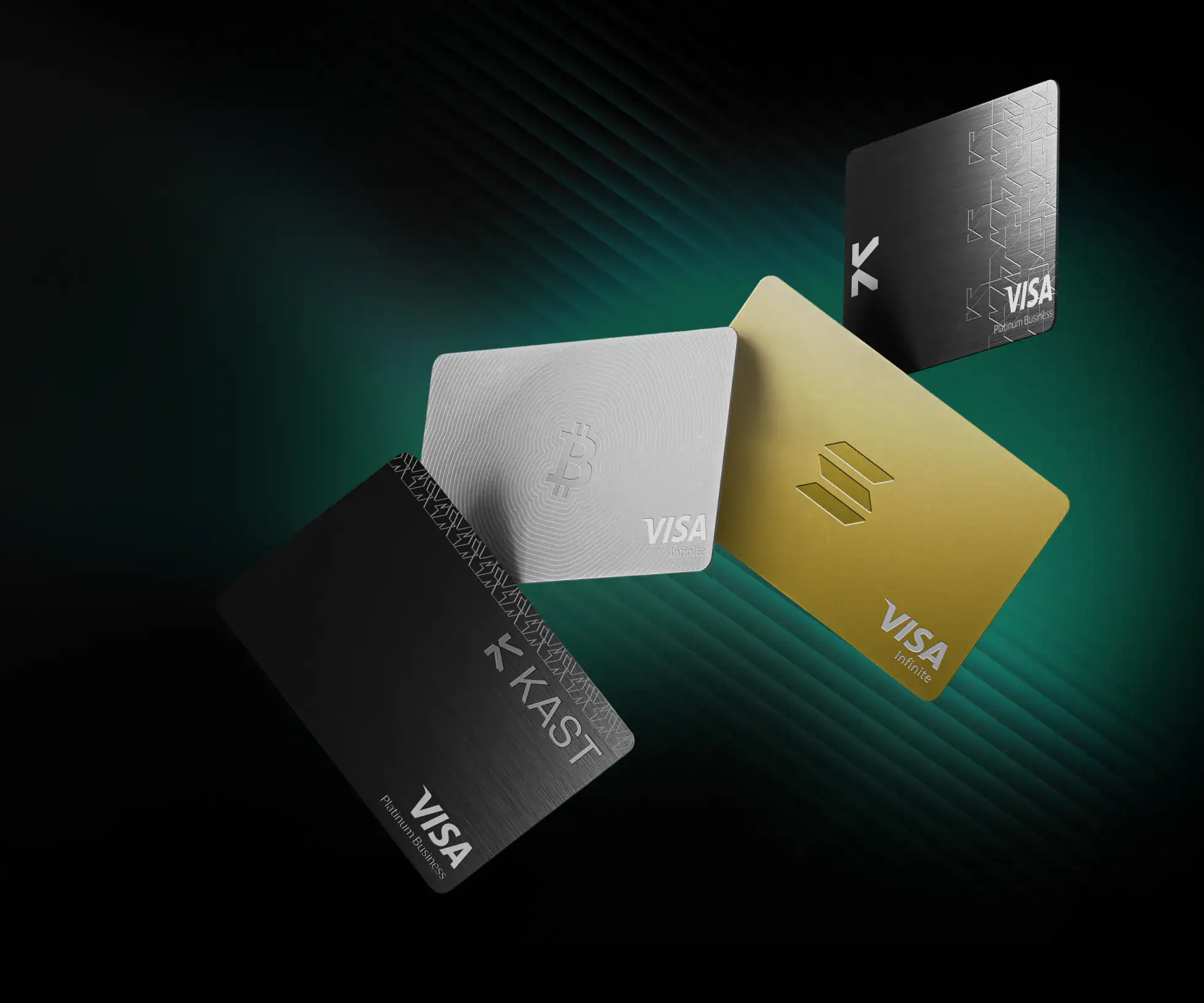
KAST is a stablecoin account with Visa cards. Deposits in supported stablecoins show up as USD at a 1:1 rate with 0% spread, and the cards spend that balance. KAST describes itself as a financial technology company, not a bank, with cards and accounts provided by licensed partners. Three tiers exist: Standard (free), Premium ($1,000 a year) and Private ($10,000 a year).
RedotPay is a stablecoin payment app with virtual and physical cards that work at merchants accepting major card networks. You deposit crypto (USDT, USDC, BTC, ETH and others are supported), and the app converts it into the payment currency at the moment you pay. Around the card it adds P2P trading, Earn, Credit and bank transfers.
Which one can you get where you live?
This is the part most comparisons skip. RedotPay publishes three separate lists, and being absent from all of them is not an approval. KAST publishes no country list: it shows the countries it supports in the sign-up dropdown.
| Where you live | RedotPay | KAST |
|---|---|---|
| United States | Not available: on the KYC, issuance and delivery lists | Verification path for US residents (Social Security number is requested) |
| India, Indonesia, Singapore, Turkey, Morocco | No card issued to residents (issuance list, 28 Aug 2026 version) | Check the sign-up country list |
| Mainland China | Not available (KYC list) | Check the sign-up country list |
| Egypt, Palestine, Tunisia | Virtual card possible, but physical cards are not delivered | Check the sign-up country list |
| Most other countries | Allowed if you are not on the lists; approval is still individual | Allowed if your country appears in the sign-up list |
If you live in the US, the choice is already made, and our best crypto cards for US residents guide covers the alternatives. Readers in India can see the India page, and the crypto card finder filters cards by where you live.
Fees side by side
| Fee | KAST (Standard) | RedotPay (free plan) |
|---|---|---|
| Annual or monthly fee | $0 (Premium $1,000 a year, Private $10,000 a year) | Account maintenance waived (Pro plan is optional: $12.90 a month or $129 a year) |
| Virtual card | Free; 2 included, extra card $2 (some regions charge $2 on all Standard virtual cards) | $10 one-time |
| Physical card | $0 card fee + $40 shipping; 7–10 business days on KAST’s site, up to 21 for international orders | $100 one-time; standard mail free, DHL priced at checkout |
| Card spend in USD | 0% | 1.00% transaction line (cryptocurrency conversion) |
| Non-USD or non-default currency | 0.5%–1.75% FX, depends on residence, merchant country and card program | 1.20% extra, so about 2.2% in total |
| Apple Pay / Google Pay fee | 0% | None listed in the fee table; a free card upgrade is needed for Apple Pay |
| ATM withdrawal | $3 + 2% (+ FX if non-USD); $500 per withdrawal, 3 per 24 hours in the Help Center | 2% (3% on the USD card above $10,000 a month); physical card only, 3 a day and 30 a month |
| Small or declined payments | $0.10 on non-USD payments under $25; $0.50 declined for low balance | $0.20 on payments of $1 or less after 5 free a month; $0.50 declined after 3 free a month |
| Crypto deposit | 0% (network fee still applies) | Free on RedotPay’s side (network fee still applies) |
| Card spending limit | No fixed cap; checks may apply | $100,000 per transaction, $1,000,000 a day |
One caution on RedotPay: its Help Center lists the 1.00% line as a “cryptocurrency conversion fee” but does not spell out which payments it applies to. Merchant-specific fees also exist (a 1.5% fee, minimum $0.50, on a short list of merchants). The fee screen in the app is the number to trust before you pay.
What $300, $1,000 and $3,000 a month really cost
I ran the official fee tables through three monthly spend levels. Assumptions: you keep all balances in stablecoins, KAST cashback applies to every purchase (some merchant categories are excluded in practice), RedotPay’s 1.00% line applies to every card payment and the 1.20% line to non-default-currency payments (the USD card is the default for dollar merchants), and the Pro plan’s cashback is earned on all spend through Apple Pay or Google Pay. A plus sign is money back, a minus sign is money paid, per month.
| Monthly spend | KAST, USD merchants | KAST, non-USD merchants (best to worst FX) | RedotPay, USD merchants | RedotPay, non-USD merchants | RedotPay Pro monthly, USD merchants |
|---|---|---|---|---|---|
| $300 | +$4.50 | +$3.00 to −$0.75 | −$3.00 | −$6.60 | −$6.90 |
| $1,000 | +$15.00 | +$10.00 to −$2.50 | −$10.00 | −$22.00 | −$4.90 |
| $3,000 | +$30.00 | +$15.00 to −$22.50 | −$30.00 | −$66.00 | −$24.90 |
Reading it: on USD payments KAST pays you back at every level. On non-USD payments its cashback covers the FX fee at low spend, but cashback stops at $2,000 a month while FX keeps charging, so the worst case turns negative. RedotPay costs money at every level on the free plan. The Pro plan only beats the free plan above about $430 a month through Apple Pay or Google Pay, and the best case is $5.10 a month after the plan fee (reached at $600 and up). RedotPay’s cashback also lands as USDs that expire after 30 days and can only be spent on future card payments.
Cashback, memberships and what changed
| KAST tier | Annual fee | Cashback | Monthly spend cap | Card |
|---|---|---|---|---|
| Standard | $0 | 1.5% | $2,000 | Visa Platinum |
| Premium | $1,000 | 2% | $10,000 | Visa Infinite |
| Private | $10,000 | 3% | $40,000 | Visa Infinite |
- KAST Points end on 30 November 2026. Points will convert in early December 2026, and the rewards you should compare now are the cashback rates above.
- KAST Reserve Rewards (a promotional rate for USD kept in a KAST Reserve account) is 8% on Standard until 30 June 2027 or $100 million in deposits, whichever comes first. KAST says it is not interest and can change, so I leave it out of the card math.
- RedotPay Pro adds 3% cashback on Apple Pay and Google Pay (up to $18 a month), a one-time waiver of the card fee (virtual on monthly, physical on annual), a $1,000 monthly ATM-fee waiver on the annual plan and +1% APY on Earn.
- If you saw KAST quoted at 6% cashback elsewhere, that figure no longer appears on KAST’s current fee pages.
Getting started with each
KAST
- Download the app and sign up with a phone number, Apple, Google or email, then set a 6-digit PIN.
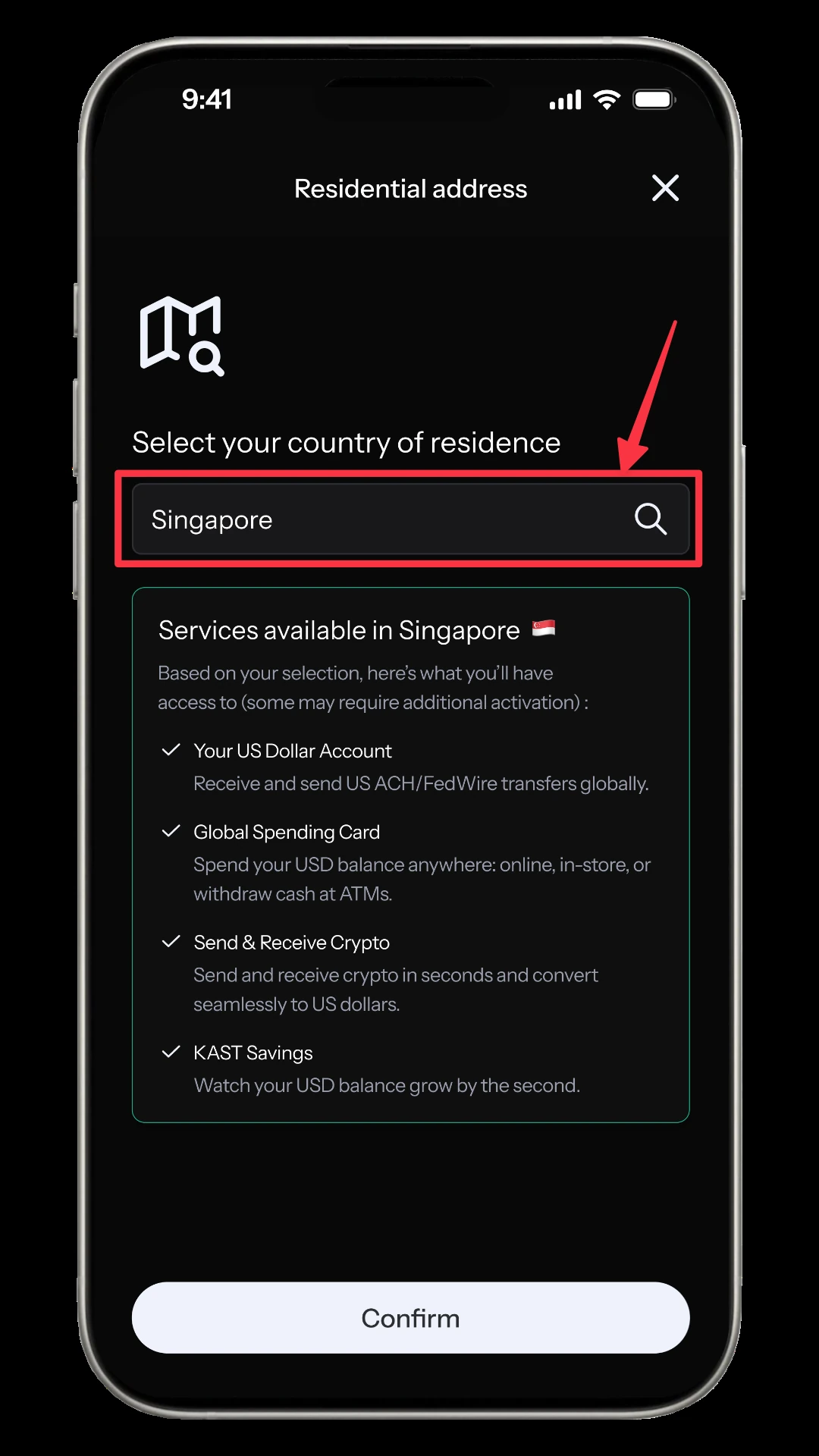
- Pick your country of residence and read which services are open there.
- Tap Verify your identity (Level 2): ID document, address, a short questionnaire and a selfie liveness check. US residents also enter a Social Security number. Level 2 unlocks the cards.
- Open the card icon, choose Order a card, and pick Virtual (free) or Physical + Virtual ($40 shipping).
- Tap Receive to deposit USDT, USDC, PYUSD or RLUSD, then add the card to Apple Pay or Google Pay if your registered country supports it.
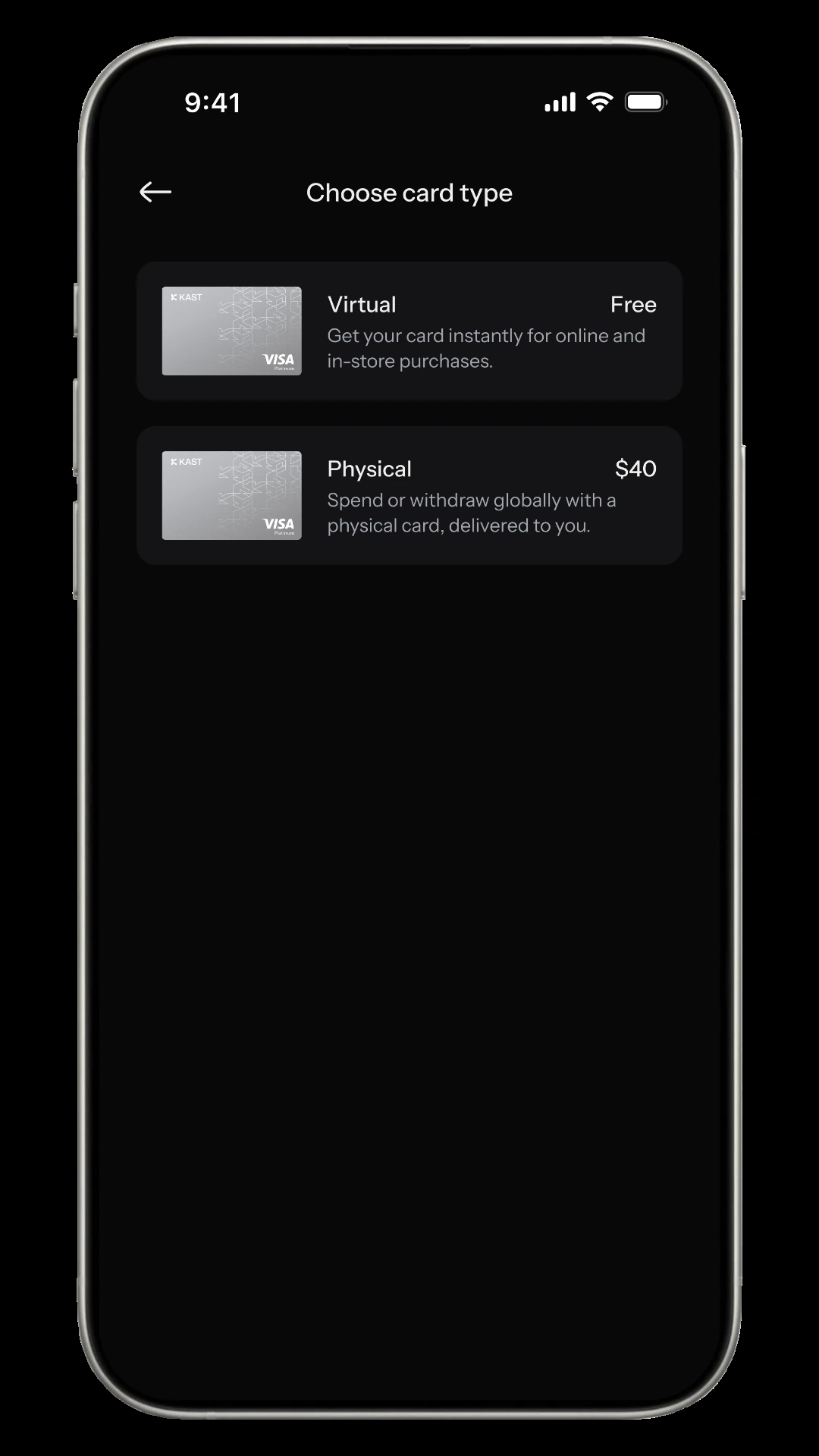
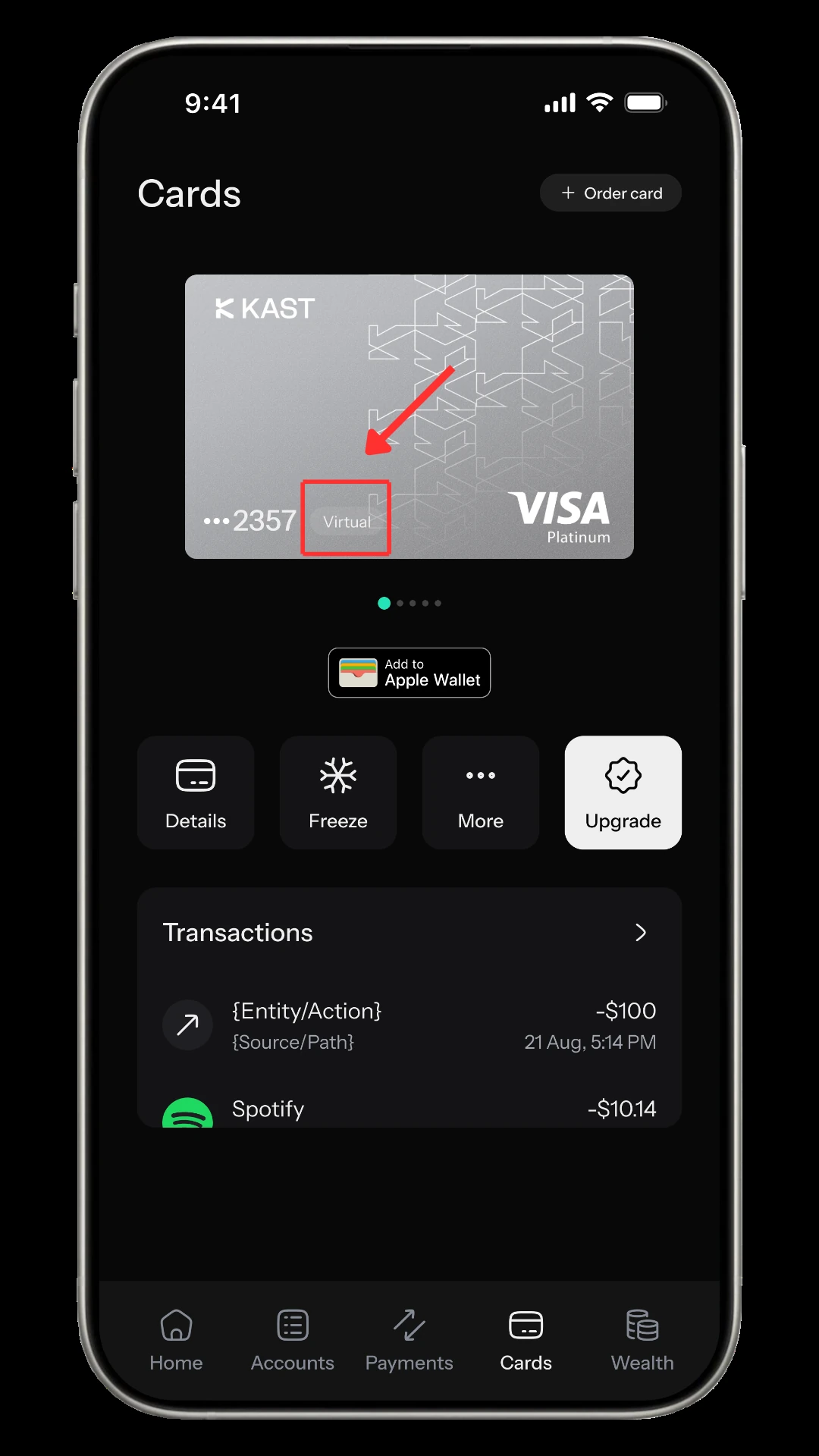
Two screens in order: the card type choice, then the card page after creation.
RedotPay
- Download the app from the App Store or Google Play and sign up with email, Google or Apple ID (not available to US residents).
- Complete identity verification in the app.
- Add crypto by on-chain deposit or Buy crypto. Pick the network that matches the coin, for example USDT on TRC20.
- Open Card and choose a virtual or physical card. For Apple Pay, update to app version 3.0.1 or higher, tap Upgrade in Card (free, new card number and 3-year expiry), then add the card to Apple Wallet.
The RedotPay sign-up reward is 5 USDs, valid for 30 days and not usable for card application fees. Full walkthrough: RedotPay card guide and KAST card review.
What reviewers complain about
Trustpilot, read on 4 November 2026: KAST holds 2.8 out of 5 across 278 reviews (38% five-star, 55% one-star). RedotPay holds 3.5 out of 5 across 1,157 reviews (55% five-star, 34% one-star). Both profiles are polarised, and both companies reply to most negative reviews.
- KAST: one reviewer wrote that about 2,000 USDS of their own money was still locked, and another waited over 30 days for a case to be resolved. Praise focuses on spending stablecoins easily and an active team.
- RedotPay: one reviewer said a deposit was not credited for 3 days and then triggered extra questions; another complained about a P2P order cancelled one minute after creation. A 5-star reviewer called setup “easy” and said RedotPay makes banks “look useless”.
- Reddit and X searches were unavailable when I wrote this, so the picture above rests on Trustpilot only. Treat any single review as one person’s account, not a trend.
Risks worth knowing
- Neither is a bank. Balances sit with the service, so keep only what you plan to spend and withdraw the rest to your own wallet.
- Fees and limits move. KAST’s ATM cap shows two different numbers on its own pages, and RedotPay’s fee table changes by effective date.
- Verification can take more than a selfie. KAST’s Level 3 adds proof of address, and either service can ask for more documents.
- Taxes: paying with crypto can count as a disposal in many countries. Export your transaction history.
Which one should you pick?
My take: I would check the country lists before comparing a single fee, because that settles the choice for many readers. I recommend KAST as the default wherever it is open, since the published fee tables favour it at every spend level above. RedotPay is best for readers whose country KAST does not serve, or who want P2P, Earn or Credit inside the same app as the card.
| Your situation | Better fit | Why |
|---|---|---|
| You live in the US | KAST | RedotPay is not available to US residents |
| You live in India, Indonesia, Singapore or Turkey | KAST, if the sign-up list includes you | RedotPay does not issue cards there |
| Most spending is in USD and you want cashback | KAST Standard | 0% USD spend fee plus 1.5% on the first $2,000 |
| You pay in local currency and KAST is open to you | KAST | Its 0.5%–1.75% FX is below RedotPay’s 2.2% |
| You want P2P, Earn or crypto-to-bank transfers in one app | RedotPay | Those tools sit inside the same app as the card |
| You mostly pay with Apple Pay or Google Pay above $600 a month | RedotPay Pro can work | 3% cashback, capped at $18 a month, against a $12.90 fee |
Can US residents use RedotPay?
No. The United States is on RedotPay’s KYC-unavailable list, its card issuance restrictions and its card delivery restrictions. KAST has a separate verification path for US residents.
Which is cheaper, KAST or RedotPay?
On the published fee tables KAST is cheaper at $300, $1,000 and $3,000 a month, because its USD spend fee is 0% and its Standard cashback of 1.5% covers most of the FX fee. RedotPay’s free plan costs about 1% on USD payments and about 2.2% on non-default-currency payments.
Is KAST cashback paid out as cash?
It is added to your Rewards balance as USD cashback, becomes redeemable after a timelock, and is then used first on your next card payment.
Does RedotPay’s 3% cashback apply to every purchase?
No. It needs the Pro plan, only counts Apple Pay and Google Pay transactions, is capped at 18 USDs a month, and the USDs expire after 30 days.
Can I hold both cards?
I found no rule against it in either Help Center, but each service needs its own identity verification and each has its own country limits.
Are KAST and RedotPay banks?
KAST says it is a financial technology company, not a bank, with cards and accounts provided by licensed partners. RedotPay describes itself as a stablecoin-based payment service. Neither is presented here as licensed or registered where you live.
Affiliate disclosure: some links on this page are referral links. They cost you nothing extra and the site may earn a reward. The RedotPay link carries a 5 USDs sign-up reward (30 days, not usable for card fees) and is not available to US residents. Fees and limits were checked against official KAST and RedotPay pages on 4 November 2026. Last updated 4 November 2026.