Bitget Exchange Review 2026: Is It Safe After the September Incident? Fees and Who Can Use It
Key Takeaways
- This Bitget exchange review in short: Bitget is a centralised exchange with spot, futures, copy trading and P2P, and the exchange holds your balance. Bitget Wallet is a separate self-custody app.
- Bitget says a hot wallet incident on 24 September 2026 cost about $388M, that cold wallets and user balances were unaffected and that withdrawals were fully restored on 2 October. Its Proof of Reserves page now shows 115% (snapshot 21 October) and the Protection Fund page $284M.
- Spot fees are 0.1% maker/taker, or 0.08% when you pay with BGB. Futures are 0.02% maker and 0.06% taker. Deposits carry no Bitget fee.
- Residents of the US, Canada, Singapore, Germany, France, Austria, Japan, Hong Kong, Malaysia, Thailand and other listed countries cannot use Bitget. Australia is not on that list, but ASIC warns Bitget has no Australian financial services licence for its futures.
- Identity verification needs a government ID plus a face check and takes about one business day. Trustpilot shows Bitget at 1.7 out of 5 from 1,699 reviews.
What Bitget Is: Exchange or Wallet?
The name covers two products people mix up, and the difference decides who holds your coins. I would not open either before knowing which one a guide is talking about.
| Bitget exchange | Bitget Wallet | |
|---|---|---|
| What it is | Custodial exchange: spot, futures, copy trading, P2P, Convert, Earn | Self-custody wallet app and web extension with swaps and a card |
| Who holds the keys | Bitget holds the balance in your account | You do (it also offers a social-login wallet with no seed phrase) |
| Where | bitget.com and the Bitget app | web3.bitget.com, covered in our Bitget Wallet review |
| Card | Not part of the exchange | Bitget Wallet Card, see the card guide |
Is Bitget Safe? What the Official Pages Show After September 2026
Here is the incident as Bitget itself describes it. It says an attacker exploited a zero-day flaw in a third-party security product to steal internal network credentials and forge withdrawal instructions, that cold wallets were not accessed, that user account balances were unaffected and that its User Protection Fund covered the loss. Mandiant and SlowMist assisted the investigation. These are Bitget’s statements; I found no independent audit of the fund or reserve claims.
| Date (UTC) | What Bitget says happened |
|---|---|
| 24 Sep 2026, 18:31 | First unauthorized transfer from some hot and warm wallets |
| 24 Sep, 19:05 | Reconciliation systems find a discrepancy; the security notice puts the first estimate at about $351.6M |
| 25 Sep | Estimate revised to about $387.5M after adding Zcash and TRON assets (incident update) |
| 28 Sep, 08:00 | BTC withdrawals restart first (phased schedule) |
| 29 Sep, 08:00 | ETH withdrawals restart on Ethereum, BSC, Arbitrum, Base and Optimism |
| 2 Oct | Bitget says withdrawals were fully restored (safety page) |
| Check | What Bitget publishes | Why it matters |
|---|---|---|
| Proof of Reserves | 115% total reserve ratio, snapshot 21 Oct 2026, Merkle tree published monthly (page) | Reserves above 100% of customer balances is the minimum you want to see. Check that the date is recent. |
| Protection Fund | $284M, 3,705 BTC (page) | The incident notice quoted over $464M at the time and Bitget’s safety page quotes $314M+, so the figure moves. Read the live page, not a screenshot. |
| Incident record | Security notice, phased withdrawals, Bitget’s safety summary | The same incident is described with three different loss and fund figures across Bitget’s pages. |
| Trustpilot | 1.7 / 5 from 1,699 reviews, 75% one-star (viewed 3 Nov 2026) | Many complaints are about frozen accounts and rejected withdrawals. Trustpilot reviews are unverified, but the pattern is worth knowing. |
My read: publishing reserve and fund figures is a point in Bitget’s favour, but the incident and the shifting fund figure mean I would keep only what I am actively trading on the platform and withdraw the rest to my own wallet. That is a habit I would apply to any centralised exchange.
Who Cannot Use Bitget, and the Australian Position
The Terms of Use (updated 20 October 2026) list Prohibited Countries that include the United States, Canada, Singapore, Germany, France, Austria, Japan, Hong Kong, Malaysia, Thailand, Russia and Belarus, among others. Using a VPN to get around the restriction is banned in section 8.6. Read the full list in the Terms of Use before you register.
Australia is not on the list. ASIC’s investor alert of 28 July 2025 adds two caveats: Bitget is registered with AUSTRAC for exchange services, but it holds no Australian financial services licence, and ASIC says its futures were offered to Australians at up to 125:1 leverage when ASIC limits certain crypto derivatives to 2:1. ASIC says Australians who use unlicensed products cannot access the dispute-resolution and client-money protections that licensed ones carry. The alert is aimed at futures, and it is short enough to read in full: ASIC investor alert.
Bitget Fees: Spot, Futures, BGB Discount and VIP Levels
| Fee | Rate | Source note |
|---|---|---|
| Spot (VIP0) | 0.1% maker / 0.1% taker | Fee page |
| Spot with BGB | 0.08% / 0.08% (20% discount) | Needs BGB in your balance |
| Futures (standard) | 0.02% maker / 0.06% taker | Fees FAQ |
| P2P and Convert | 0% | Fees FAQ |
| Deposit | No Bitget fee; network fee still applies to the sending side | Deposit guide |
| Copy trading | Profit share to the lead trader, typically 10%-20% of realised profit, only on winning closes | Set by each lead trader |
| VIP level | 30-day spot volume (USDT) | Balance (USDT) | Spot maker / taker | With BGB | 24h withdrawal limit (USDT) |
|---|---|---|---|---|---|
| VIP0 | any | any | 0.1% / 0.1% | 0.08% / 0.08% | 3,000,000 |
| VIP1 | 500,000+ | 30,000+ | 0.08% / 0.08% | 0.064% / 0.064% | 4,000,000 |
| VIP2 | 2,000,000+ | 50,000+ | 0.065% / 0.07% | 0.052% / 0.056% | 6,000,000 |
| VIP3 | 8,000,000+ | 250,000+ | 0.05% / 0.06% | 0.04% / 0.048% | 8,000,000 |
A worked example, in USDT because that is how Bitget quotes it: a 1,000 USDT spot buy costs 1 USDT at the VIP0 rate or 0.80 USDT with the BGB discount. A 10,000 USDT futures position costs 6 USDT to open as a taker or 2 USDT as a maker, before the funding fee that perpetual contracts charge every eight hours. VIP1 starts at 500,000 USDT of monthly spot volume, so most beginners will stay on VIP0 and the BGB discount is the lever that matters. Sources: fee schedule and fees FAQ.
Withdrawals cost a network fee that Bitget shows before you confirm, and the fee page says VIP users without identity verification are capped at 20,000 USDT per 24 hours.
How to Register and Verify Your Identity
- Register on Bitget with an email address or phone number and set a strong password, then turn on two-factor authentication.
- On the app home screen tap Verify on the identity verification banner (or open your profile and tap Unverified, then Individual Verification).
- Choose your country of residence and issuing country, pick an ID type (passport or driver licence), enter your full name and photograph the document on a plain background.
- Complete the face recognition check. The app shows an estimated review time of 60 minutes; the help article says processing typically takes one business day, with an email once it is approved or if more information is needed.
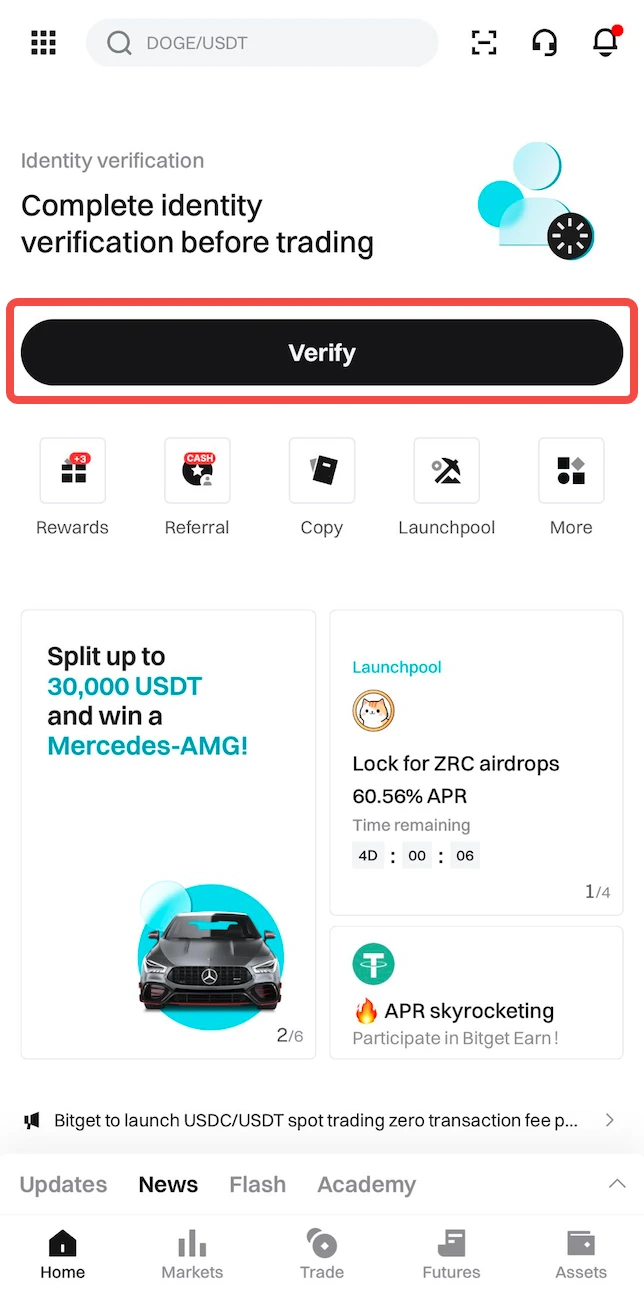
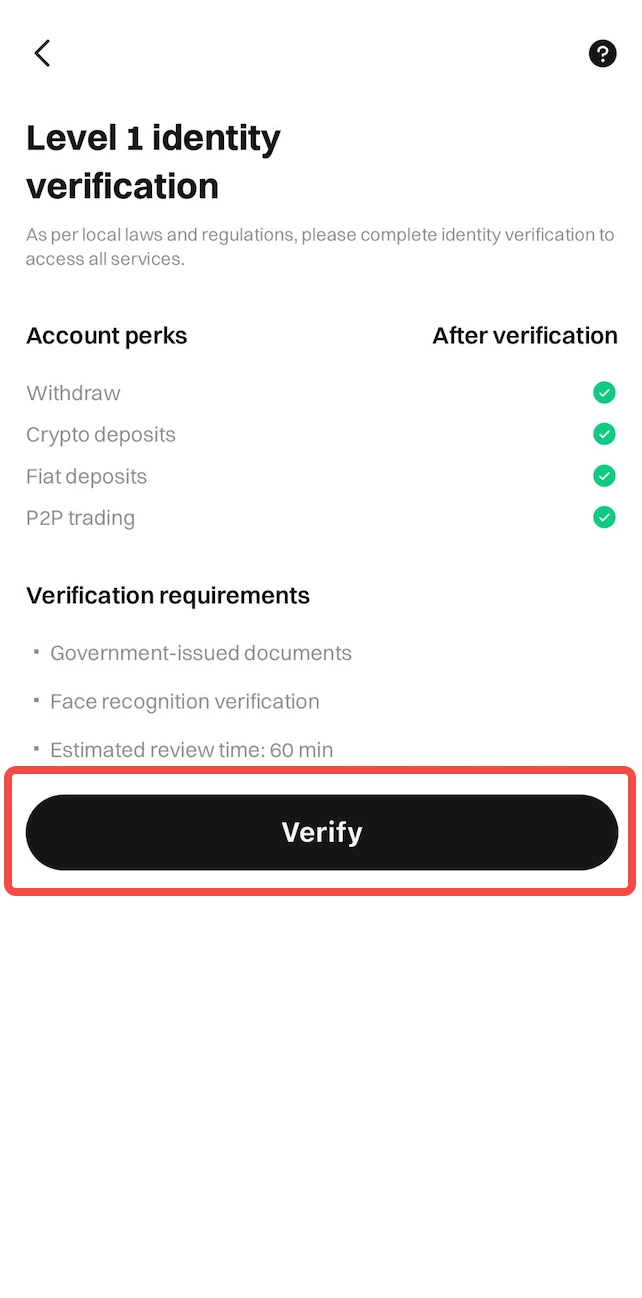
After Level 1 the app lists withdrawals, crypto deposits, fiat deposits and P2P trading as enabled. The full walkthrough is in Bitget’s KYC mobile guide. If review takes longer than a business day, Bitget asks you to open a support ticket with your UID.
How to Deposit: Crypto Transfer From an Exchange You Already Use
A common route is to buy USDT on an Australian exchange you already use and send it to Bitget by crypto transfer. The steps follow Bitget’s deposit guide, and our deposit and withdrawal guide covers P2P and withdrawals:
- Tap Add funds, then Deposit crypto, and pick the coin (for example USDT).
- Choose the network. It must match the network your sending exchange or wallet will use, such as ERC-20 or TRC-20. A wrong network can lose the funds permanently.
- Pick the destination account (Spot is the default) and copy the address or scan the QR code. Note the minimum deposit shown on that page.
- Send a small test amount first, wait for the network confirmations, then send the rest. Your balance appears under Assets.
Copy trading mirrors a lead trader’s orders in your account. Bitget’s fees FAQ says followers pay a profit share, typically 10% to 20% of realised profit, on top of normal trading fees and, for futures copies, funding fees. Each lead trader sets their own percentage, and it is charged only when a copied trade closes in profit.
| Copied trade result | Profit share (15% example) | What you carry |
|---|---|---|
| Closes +200 USDT | 30 USDT to the lead trader | 170 USDT before trading fees |
| Closes -200 USDT | 0 USDT | The full 200 USDT loss plus trading fees |
The asymmetry is the point: the lead trader shares your gains but not your losses, so I would read a lead trader’s percentage and drawdown on their own page before following anyone, and start with an amount I could lose.
Who Bitget Is Best For, and Who Should Look Elsewhere
- Suits: traders outside the prohibited countries who want copy trading, a wide coin list and low spot fees through BGB.
- Think twice: anyone who wants futures covered by an Australian licence. ASIC’s alert is about exactly that product, and Trustpilot reviews describe frozen accounts and blocked withdrawals, so finish verification and test one withdrawal before moving large sums.
- Not available: residents of the countries on the Terms of Use list. If you are one of them, see our Bybit guide for another exchange and check that it accepts residents of your country first.
I would register, verify, move a small amount and test one withdrawal back out before using copy trading.
Frequently Asked Questions
Is Bitget safe?
Bitget publishes a 115% Proof of Reserves ratio (21 October 2026) and a Protection Fund of $284M. It also had a hot wallet incident on 24 September 2026, which it says was covered by the fund with cold wallets untouched. Treat any centralised exchange as counterparty risk and keep only what you trade there.
Can Australians use Bitget?
Australia is not on Bitget’s Prohibited Countries list. ASIC says Bitget is registered with AUSTRAC for exchange services but has no Australian financial services licence and warned about its futures products in July 2025.
What is the difference between Bitget and Bitget Wallet?
Bitget is a custodial exchange where the platform holds your balance. Bitget Wallet is a separate self-custody app at web3.bitget.com where you control the keys.
How much are Bitget fees?
Spot is 0.1% maker and taker, 0.08% with BGB. Futures are 0.02% maker and 0.06% taker. P2P and Convert are free and Bitget charges no deposit fee.
How long does Bitget KYC take?
The app shows about 60 minutes and the help article says typically one business day. It needs a government-issued ID and a face recognition check.
Which countries cannot use Bitget?
The Terms of Use list includes the United States, Canada, Singapore, Germany, France, Austria, Japan, Hong Kong, Malaysia, Thailand, Russia and Belarus, plus others. Using a VPN to bypass restrictions is prohibited.
Last updated: 3 November 2026. Disclosure: this page contains Bitget referral links and the referring party may earn a reward if you sign up through them, at no extra cost to you. Referral code: f8ya. Use them only if you live in a country where Bitget is available. Fees, reserves and availability come from Bitget’s own pages and ASIC and can change.