
Binance Futures Trading Tutorial: Fees, Leverage, Funding and Liquidation [2026]
- What it is: on Binance USDⓈ-M futures you post margin and open a position several times larger than it, long or short, settled in USDT or USDC. Perpetual contracts have no expiry date (Binance help).
- Fees: a regular user pays 0.0200% maker and 0.0500% taker on USDT-margined contracts, or 0.0180% and 0.0450% when paying with BNB (official fee table). The fee is charged on the position’s notional value, not on your margin. For a different fee model, compare Hyperliquid.
- Leverage: since 7 December 2025 a new futures account cannot use more than 20x in its first 30 days (Binance help). At 20x, a move of about 5% against you uses up the initial margin.
- Opening an account: register, verify your identity, pass the Customer Knowledge Assessment, then transfer USDT to the futures wallet. Do this only if your country is not on Binance’s prohibited list and the in-app check accepts you; the full sign-up and KYC walk-through is in our Binance sign-up guide.
- Funding and liquidation: funding is settled every 8 hours (00:00, 08:00 and 16:00 UTC) and liquidation is triggered by the mark price, not the last traded price.
- Not for US persons: Binance’s own list of prohibited countries names the United States, Canada and the Netherlands among others (official list, updated 5 January 2026). Check it before you register.
- Risk tools: Demo Trading, the order-window calculator, stop orders and a Cooling Period are built in; use them before the first live order (Binance help).
What is Binance futures trading and how does it differ from spot?
On the spot market you buy the asset itself. On futures you trade a contract on the price: you put up margin and open a position larger than that margin. A 10,000 USDT position with 1,000 USDT of margin is a 10x position, and the profit or loss is calculated on the whole 10,000 USDT.
| Comparison | Spot | USDⓈ-M perpetual |
|---|---|---|
| What you hold | The asset itself | A contract; you do not receive the coin |
| Going short | Not directly | Yes, by opening a short position |
| Leverage | No | Yes, depending on account rules and position size |
| Expiry | None | Perpetual contracts have none |
| Cost of holding | None | Funding paid between longs and shorts |
| Largest possible loss | The amount you invested | Cross: the whole balance of that margin asset and its other positions. Isolated: the margin of that position |
Binance splits futures into two families in its official comparison:
| Feature | USDⓈ-M | COIN-M |
|---|---|---|
| Collateral | Stablecoins and other accepted assets | Crypto such as BTC or ETH |
| Settlement | USDT or USDC | The coin itself, such as BTC |
| Contract types | Perpetual and quarterly | Perpetual, quarterly and bi-quarterly |
| Margin modes | Cross and Isolated | Cross and Isolated |
| Wallet | Separate from COIN-M | Separate from USDⓈ-M |
This guide covers USDⓈ-M perpetuals, the contract most beginners start with. My rule of thumb is to read the fee, leverage and liquidation numbers below before you fund the account, because they decide how much room a position has.
Where Binance futures are not available
Binance publishes a List of Prohibited Countries, updated 5 January 2026. To register and use Binance Services you must not be located, incorporated, established in, resident of or a citizen of the United States, and you must not be located in or resident of Canada or the Netherlands, Cuba, North Korea, Iran, Crimea, or the so-called Donetsk and Luhansk People’s Republics. Binance may change the list without notice (official list). The page has no separate derivatives-only list.
If you live in the United States, Binance.com is not an option for you, and this article does not offer a way around it. If your country is not on the list, the app still checks availability and your identity during sign-up, so confirm there before you deposit anything.
How to open a Binance futures account, step by step
- Only if your country is eligible: follow these steps only if Binance accepts you as a user under its prohibited-country list and the in-app check.
- Create the account: register on Binance with an email or phone number, or log in if you already have one. On the home page choose Futures, then Log In or Register.
- Verify your identity: Binance requires identity verification before you trade futures (official guide). Wait for the verification to finish before you deposit.
- Pass the Customer Knowledge Assessment: new users who want to trade derivatives must pass the CKA. Binance does not publish how many questions it has (official page).
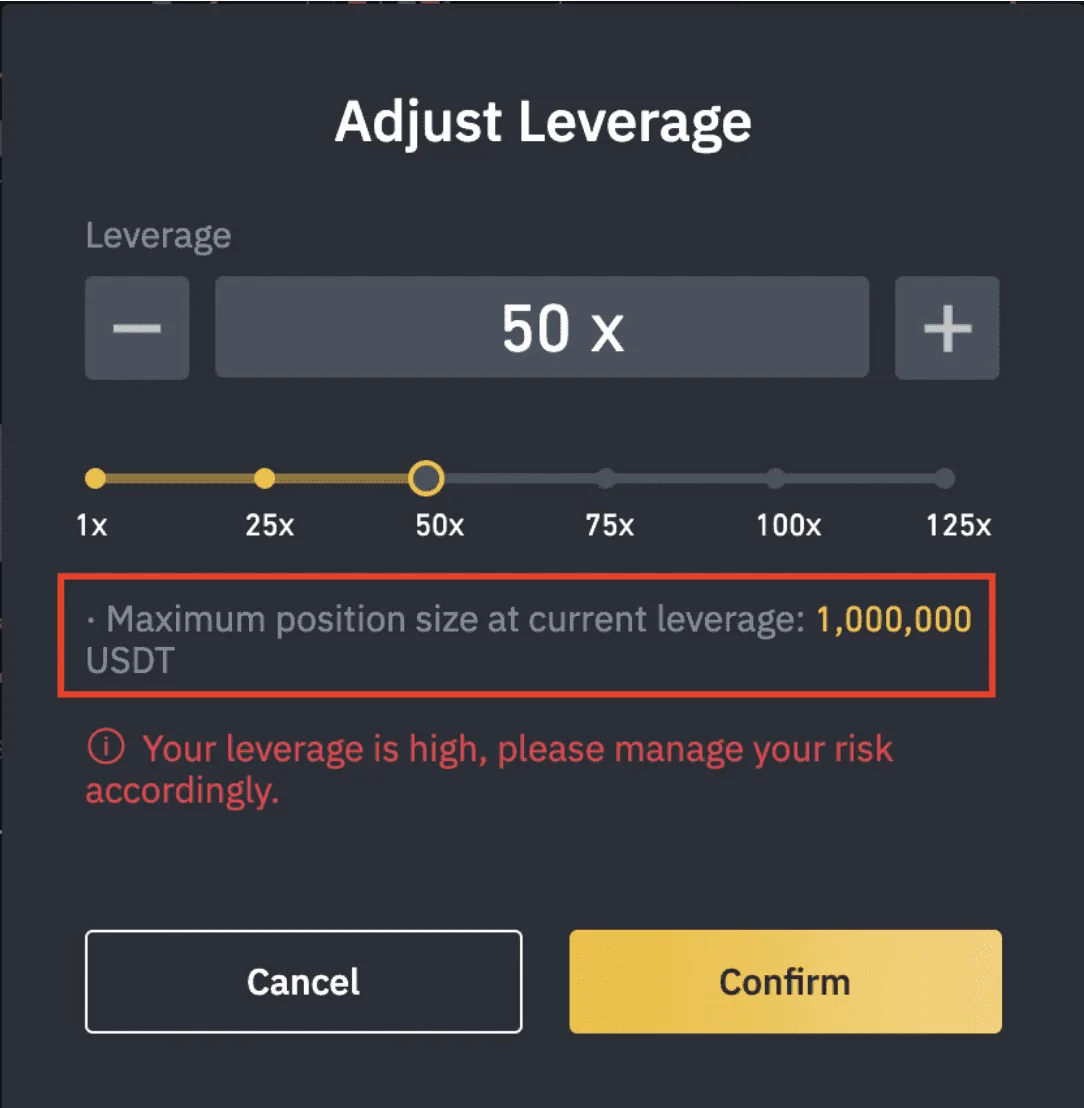
- Open the futures account: click Open Account, choose your trading experience (default leverage Beginner 2x, Experienced 5x, Advance 20x), accept the service agreement and risk notice, then click Open Now (official guide).
- Transfer funds to the futures wallet: in the futures interface open Assets, click Transfer, choose USDT or another accepted asset, enter the amount and confirm. USDⓈ-M and COIN-M use separate wallets, and internal transfers are free (official guide).
- Place the first order: pick the contract (for example BTCUSDT), set the leverage and the margin mode, choose limit or market, enter the quantity and choose Long or Short. Check the estimated liquidation price and set a stop before you confirm, and start with a very small size.
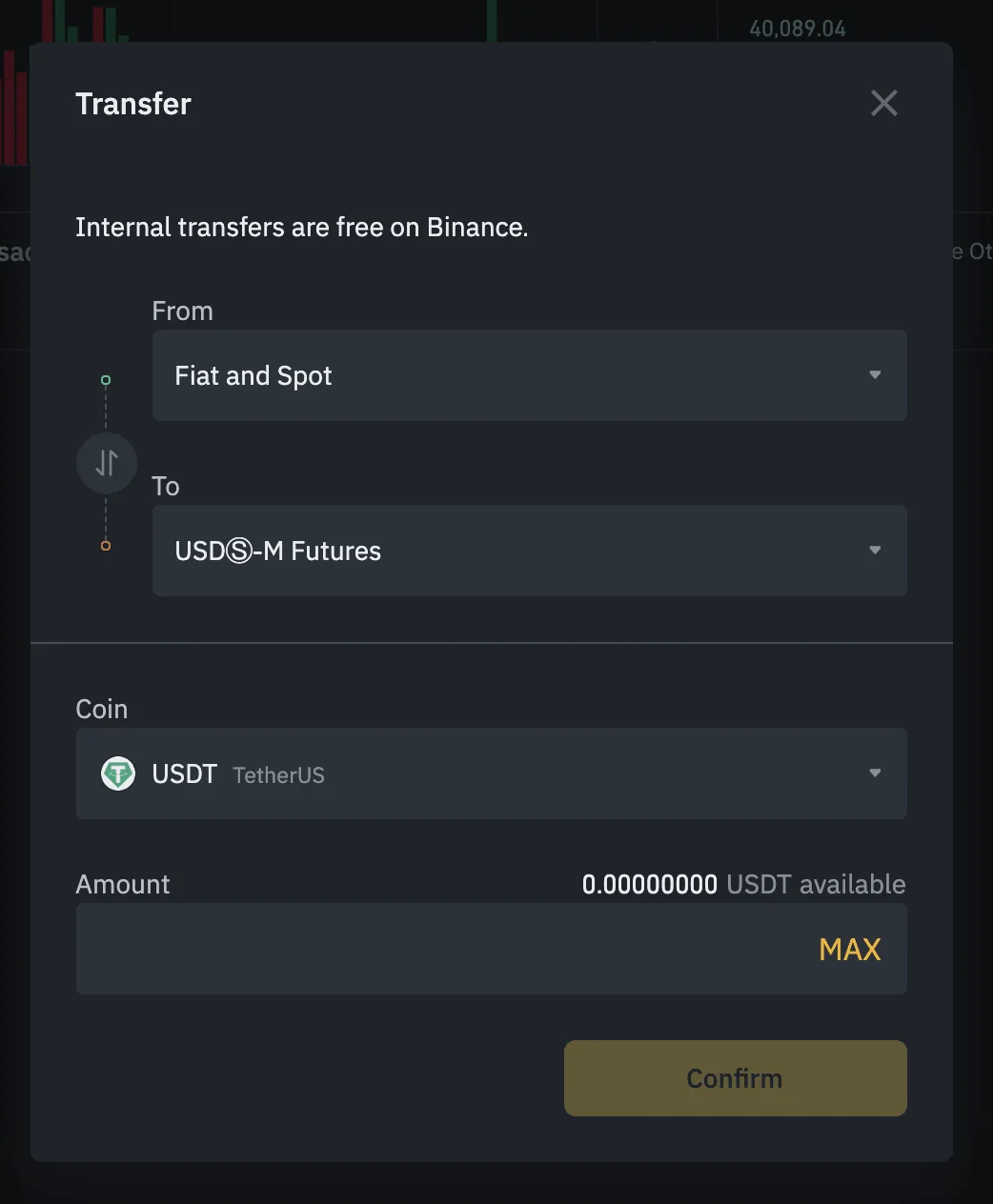
A wallet that sits unused is moved back automatically: if the futures wallet has no trades, transfers, positions or orders for 30 days and holds less than 1,000 USDT in value, the assets return to the spot wallet.
Leverage and margin: the numbers before your first trade
| Item | What Binance says |
|---|---|
| Leverage when you open the account | Beginner 2x, Experienced 5x or Advance 20x, depending on the experience you choose |
| New account | From 7 December 2025, no more than 20x in the first 30 days (also applied to accounts opened in the previous 30 days); limits are lifted gradually after 30 days |
| Sub-accounts | Since 12 August 2025, futures accounts created from a regular user’s sub-account cannot use more than 5x |
| Maximum by size | The larger the notional value of the position, the lower the maximum leverage; check the Leverage & Margin table |
| Margin mode | All contracts default to Cross; you cannot switch with open positions or orders (help) |
The table below is my own arithmetic, not a Binance figure. Take a 10,000 USDT long: leverage does not move the price, it only changes how much of your margin each move uses.
| Leverage | Initial margin | Loss on a 5% drop | Share of margin |
|---|---|---|---|
| 2x | 5,000 USDT | 500 USDT | 10% |
| 5x | 2,000 USDT | 500 USDT | 25% |
| 10x | 1,000 USDT | 500 USDT | 50% |
| 20x | 500 USDT | 500 USDT | 100% |
At 20x a 5% drop uses the whole initial margin. I would pick a leverage at which you survive an ordinary day of volatility, and test it in Binance Demo Trading first.
Cross and Isolated: what is at risk
| Mode | What is at risk | Liquidation | Suits |
|---|---|---|---|
| Cross | The whole balance of that margin asset (USDT or USDC), shared by all positions | A liquidation can take the whole Cross balance and other positions in the same asset | People who watch margin all the time |
| Isolated | Only the margin assigned to the position | Liquidated when the margin ratio reaches 100%; you can add or remove margin by hand. Multi-Assets Mode has no Isolated | People who want to cap the loss on one position |
| Switching mode (help) | Choose Cross or Isolated before opening the position | You cannot switch with open positions or orders; it applies to that contract only | Pick the mode before the first position |
Binance futures fees: three types of cost
There are three costs: the trading fee on every fill, funding (only if you hold a position at the settlement time), and an insurance liquidation fee when you are liquidated. Binance does not charge a maintenance fee on the account (official explanation).
| Tier (30-day volume) | USDT-M maker / taker | Paying with BNB | USDC-M maker / taker |
|---|---|---|---|
| Regular user (below 5,000,000 USD) | 0.0200% / 0.0500% | 0.0180% / 0.0450% | 0.0000% / 0.0400% (BNB: 0.0000% / 0.0360%) |
| VIP 1 (5,000,000 USD and at least 5 BNB) | 0.0180% / 0.0500% | 0.0162% / 0.0450% | 0.0000% / 0.0400% |
Fee table read on the Binance fee page on 29 October 2026; rates can change.
Since 2 July 2026 (10:00 UTC) there is also a temporary promotion for United Stables-margined contracts (starting with BTCU and ETHU): 0% maker and 0.04% taker for regular users, or 0.036% taker when paying the fee with BNB, “until further notice” (Binance announcement). Eligible Taker Program participants can get up to 18% off that promotional taker rate, and standard fees apply once the promotion ends. It covers those U-margined contracts only; the USDT-margined table above is unchanged.
| Example | Calculation | Result |
|---|---|---|
| Open a 10,104 USDT BTCUSDT position at market, taker (Binance example) | 10,104 × 0.05% | 5.052 USDT |
| Close an 11,104 USDT position with a limit order, maker (same example) | 11,104 × 0.02% | 2.2208 USDT |
| My calculation: open and close 10,000 USDT at market | 10,000 × 0.05% × 2 | 10 USDT, about 9 USDT with the 10% BNB discount |
| My calculation: limit order to open, market stop to close, 10,000 USDT | 10,000 × (0.02% + 0.05%) | 7 USDT round trip |
| My calculation: the same trade on 1,000 USDT of margin at 10x | 10 ÷ 1,000 | The round trip costs 1% of the margin before any price result |
| Leverage (1,000 USDT margin) | Notional value | Round trip at market (taker) | Round trip with limit orders (maker) | Taker cost vs margin |
|---|---|---|---|---|
| 3x | 3,000 USDT | 3 USDT | 1.2 USDT | 0.3% |
| 10x | 10,000 USDT | 10 USDT | 4 USDT | 1.0% |
| 20x | 20,000 USDT | 20 USDT | 8 USDT | 2.0% |
The 10% BNB discount applies on USDⓈ-M futures when the BNB sits in the USDⓈ-M futures wallet; if the BNB runs out, the system takes USDT with no discount (BNB discount). With BNB, the 10x round trip at market falls to 9 USDT and with limit orders to 3.6 USDT.
Funding: the cost people forget when they hold a position
A perpetual contract stays close to the spot price through funding. By default it settles every 8 hours, at 00:00, 08:00 and 16:00 UTC (08:00, 16:00 and 00:00 in Singapore; 05:30, 13:30 and 21:30 in India), and some contracts settle every 4 hours. Only people holding a position at that moment pay or receive: when the rate is positive longs pay shorts, when it is negative shorts pay longs. Funding = notional value × funding rate, and Binance takes no cut (official explanation).
Suppose a rate of 0.01% per period (the base interest component; the real rate moves with the market). A 10,000 USDT long pays 1 USDT per period, 3 USDT a day and about 90 USDT over 30 days, 0.9% of the position. Held for a week it is 21 USDT, or 2.1% of a 1,000 USDT margin; at 10x leverage that is 9% of the margin a month before any price result. In the app you can set a funding-rate alert, which by default fires when the estimated rate reaches 0.25%.
Liquidation: how it happens, with numbers
Binance liquidates on the mark price, not on the last traded price. The margin ratio is maintenance margin divided by margin balance; at 100% the position is liquidated, and Binance recommends keeping the ratio below 80% (official example). In the official example, Alice and Bob open a 1 BTC BTC/USDT perpetual at 55,000 USD with 20x leverage, 5% initial margin and 0.5% maintenance margin.
| Item | Alice (long) | Bob (short) |
|---|---|---|
| Contract and size | BTC/USDT perpetual, 1 BTC | BTC/USDT perpetual, 1 BTC |
| Entry price and notional value | 55,000 USD | 55,000 USD |
| Leverage, initial and maintenance margin | 20x / 5% / 0.5% | 20x / 5% / 0.5% |
| Wallet balance | 5,000 USDT | 5,000 USDT |
| Liquidation price | 50,200 | 59,750 |
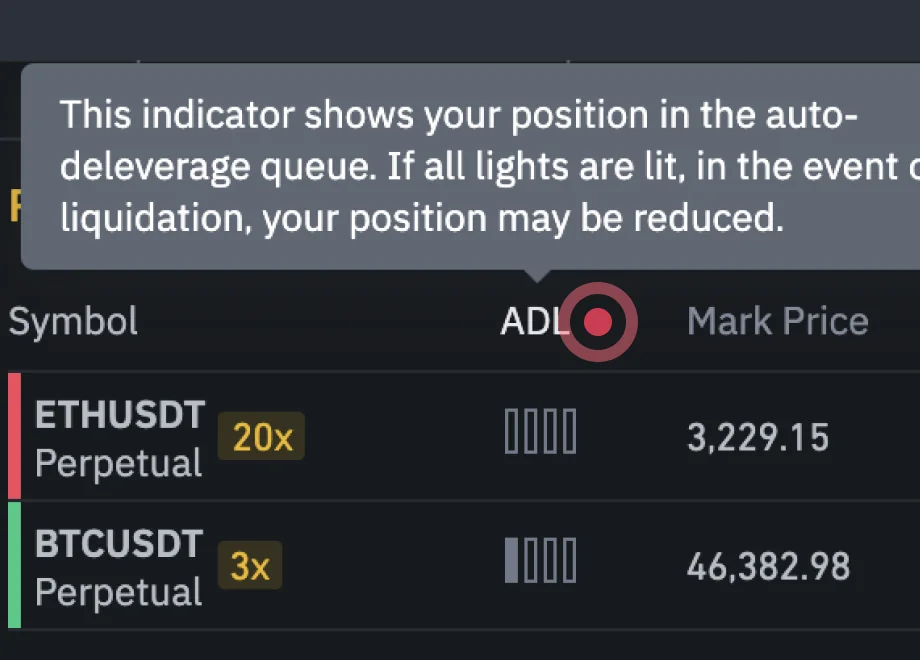
The price reaches 50,200 before it gets to 49,500: a fall of 8.7% (4,800 USD from 55,000) already closes Alice’s position by force. When the price drops 10% to 49,500 she is long gone, and Bob’s short shows a paper gain of 5,500 USD. If the liquidation happens beyond the bankruptcy price, the insurance fund covers the gap, and only after that can auto-deleveraging (ADL) apply.
Beginners usually trip on two things. The liquidation price uses the mark price and the maintenance margin, not the last price on the chart, so an unattended position closes earlier than it looks. And the cost of a position is not only the fee but funding every 8 hours, which weighs more the longer you hold.
Because a liquidation level depends on the mark price and the maintenance margin, I would test the whole flow with a very small amount, set a stop on every position and read the mark-price rule above before trusting any single liquidation number.
How to lower the chance of liquidation
- Watch the margin ratio and add margin: Binance recommends keeping it below 80%.
- Use stop orders and choose on purpose between Mark Price and Last Price as the trigger.
- Do not add to a losing position: Binance itself treats this as a mistake because the liquidation price moves toward the market.
Binance’s example: 500 USDT of margin, 20x, a 1,000 USDT BTCUSDT long at 50,000 USD, liquidation price 25,100.40. If the price falls 10% to 45,000 and you add another 1,000 USDT, the total liquidation price rises to 35,857.67 (official explanation).
Risk control tools
| Tool | What it does | Limit according to the documentation |
|---|---|---|
| Stop / Take-Profit | Closes the position to cap a loss or lock in a gain; the trigger can be Last Price or Mark Price (triggers) | Liquidation always uses the Mark Price |
| Price Protection | Stops a stop order from triggering when the last price is far from the mark price (details) | Set per order; API orders are not affected |
| Cooling Period | Pauses futures for 1 day, 1 week, 1 month or indefinitely (setting) | Once activated, it cannot be ended early; reduce-only orders are still allowed |
| Calculator | Estimates margin, profit/loss and liquidation price before you send the order (calculator) | An estimate |
| Knowledge assessment (CKA) | New users must pass it before trading futures or margin (Responsible Trading) | The page does not state the number of questions, so none is given here |
| Demo Trading | Practice with virtual money (help) | The old Mock Trading is now part of Demo Trading |
Five mistakes that burn margin fastest
- High leverage with no slack: by the table above, at 20x a move of about 5% removes the margin.
- Forgotten funding: a position held for days accumulates cost and eats the profit.
- Adding to a loser: Binance calls this a mistake because the liquidation price creeps toward the market.
- Cross margin without control: the whole balance of that asset is at risk, not one position.
- Judging liquidation by the last price: the Mark Price decides, and the position can close at a price you never saw on the chart.
Honest verdict: who Binance futures suit
| Makes sense if | Does not make sense if |
|---|---|
| You understand that the loss is calculated on the whole position, not on the margin | You expect a guaranteed return or fixed income |
| You can lose the whole margin of a position without hurting your finances | You will need that money in the next few months |
| You check the liquidation price and the margin ratio before you send an order | You cannot watch the position and do not use a stop |
| Your country is not on Binance’s prohibited list and the in-app check accepts you | You are a US person: Binance.com is closed to you and this guide proposes no workaround |
Net cost in numbers
- Short-term trading: a 10x round trip at market costs 1% of the margin (10 USDT on 10,000 USDT); with limit orders both ways it is 0.4% (4 USDT), and about 0.36% with BNB. Limit entry plus a market stop costs 0.7% (7 USDT).
- Holding: at a funding rate of 0.01% per 8 hours, a 10,000 USDT position pays 21 USDT a week, 2.1% of a 1,000 USDT margin. Funding, not the fee, is what hurts long holds.
- Cheapest combination: limit orders, BNB for the fee, the lowest leverage that fits the plan, and short holding periods.
A one-week plan for people who can use the product
- Days 1 and 2. Demo Trading with virtual money: open and close a position with a limit and a market order and compare the fee with the table above.
- Day 3. Use the calculator in the order window to see the liquidation price at 2x, 5x and 10x before you decide.
- Days 4 and 5. If you are eligible and go live (a referral sign-up link is the same route as the sign-up step above), use a very small size, Isolated margin, and a stop on every position.
- Days 6 and 7. Add up the fees and funding you paid and compare them with the result; if costs ate the gain, lower the frequency or the leverage.
Frequently asked questions
Can I trade Binance futures from the United States?
No. Binance’s List of Prohibited Countries (updated 5 January 2026) names the United States, and Binance says it cannot register or serve people located in, incorporated in or resident of it, or citizens of it. Canada and the Netherlands are also on the list.
What are the Binance futures fees?
On USDT-M, a regular user pays 0.02% maker and 0.05% taker, or 0.018% and 0.045% with BNB. On USDC-M, 0% maker and 0.04% taker. The fee is charged on the notional value of the position, not on the margin.
When is funding charged on Binance futures?
By default every 8 hours, at 00:00, 08:00 and 16:00 UTC; some contracts use 4 hours. Only people holding a position at the moment of calculation pay or receive: when the rate is positive longs pay shorts, when it is negative shorts pay longs, and Binance takes no cut.
Which price decides liquidation?
The mark price, not the last traded price. A position is liquidated when the margin ratio reaches 100%, and Binance recommends keeping it below 80%.
What leverage can a new futures account use?
Since 7 December 2025, at most 20x in the first 30 days after you open the futures account; after that the limits rise gradually and depend on the contract and position size.
What is the difference between a perpetual and a quarterly contract?
A perpetual has no expiry and stays near the spot price through funding. A quarterly contract has an expiry date and does not charge funding.
Read next
- How to Register on Binance and Deposit Funds in 2026: the step before you open the futures account, with KYC and deposit routes.
- Hyperliquid Fees and Tutorial 2026: perpetual contracts on an on-chain exchange with a different fee model, for comparison.
- Backpack Exchange Review & Tutorial [2026]: another exchange with perpetual futures, for comparing fees and onboarding.
This article is general information, not investment or legal advice. The Binance sign-up links on this page are referral links: if you open an account through them, the referring party may earn a commission at no cost to you (referral ID 11128920). Last updated: 29 October 2026. Fees and rules were read on Binance’s official pages on 29 October 2026 and may change. Trading futures can lose you the whole margin of a position.